Progress tracking will be enabled once user accounts are connected.
The Observing Self
The Observing Self
The Observing Self is part of you that stands slightly apart from experience, able to notice how you think, behave, feel and relate without being swept away by it. It’s your authentic or core self that observes, reflects, and decides. In retirement, this self becomes essential. It helps you separate from unhelpful identities and patterns to see clearly and make conscious choices about how you want to live this next stage. Your Observing Self is the part of you that leads your transformation, the part that wants you to thrive and survive well in retired life.
Session Objectives
This session introduces the Observing Self, otherwise known as your core or authentic self, the part of you that oversees your inner and outer worlds, reflects clearly and strategically and makes decisions that support your progress toward and in retirement.
By the end of this session, you will be able to:
• Recognise the role of your Observing Self as the central, guiding presence in your life
• Understand how sub-selves influence your thoughts, behaviours, feelings and relationships
• Identify when your Observing Self is active and when your Negative Self, has taken control
• Practise stepping back into your Observing Self to regain perspective and control
• Strengthen your confidence in leading your own transformation before, during, and after retirement

The Observing Self and the Brain
For anyone interested in how psychology and neuroscience connect, modern research helps explain the Observing Self in action. When you pause and notice your thoughts, behaviours, feelings and relationships instead of reacting automatically, different areas of the brain come online:
- The prefrontal cortex supports awareness, planning, and reflection, the neural base of your Observing Self.
- The limbic system, which manages emotion and threat detection, calms when observation replaces reactivity.
- Neural integration between these regions improves emotional regulation, decision-making, and perspective.
In retirement, this ability to observe rather than react keeps the mind-body system balanced, allowing you to respond positively and helpfully to change. Each time you activate your Observing Self, you strengthen the neural pathways that underpin psychological flexibility and resilience.
Modern science is now proving what ancient traditions understood intuitively: awareness itself heals. The capacity to distance ourselves from what life throws at us and to observe it has always been the key to a well-directed life.
Understanding Your Sub-Selves
Surrounding your Observing Self, who, remember, is the boss, the chief, and the decision-maker, are your sub-selves, distinct parts of you that each play specific roles in your life. Each sub-self brings particular qualities, characteristics, and ways of thinking, behaving, feeling, and relating to people and situations. They include familiar characters such as the Explorer, the Achiever, the Helper, the Protector, the Carer, and the Organiser.
When your Observing Self is in charge, these parts work in harmony. It brings a sub-self forward when needed, temporarily swapping places to allow them to play their role. When they’ve finished, your Observing Self resumes its central position. This balance ensures that your sub-selves and Observing Self all pull in the same direction. Everyone is working together for your retirement.
Sometimes, though, it doesn’t work out this way. Difficulties arise when one particular sub-self refuses to step back, your Negative Self.
Now, we all have a Negative Self, and in normal circumstances, they play a valuable role as we all need to be ‘negative’ at times. However, unlike other subselves, Negative Selves often attempt to cling to power, such is their liking for it and can dig their heels in when the Observing Self seeks to swap places with them again after they have fulfilled their role.
From that point, your Negative Self controls how you think, behave, feel, and relate to the world and the people in it, which, as I am sure you can imagine, is not conducive to a successful retirement.
Your task is to restore control to your Observing Self so that it can send your Negative Self back to its intended location, on the periphery of your life alongside your other sub-selves, there to be brought on when needed.
To get a visual representation of the Observing Self Concept, watch my animation.
illustration/animation from book/youtube
copy and paste from book
You are not your Negative Self
When the Negative Self takes control, life becomes difficult. It throws everything at you that it can, all the ‘weapons’ at its disposal to retain control. These include:
- Physical symptoms such as chest pain, stomach issues, and headaches
- Negative, intrusive thoughts
- Difficult emotional states such as stress, anxiety, depression, and anger
- Problematic behaviours such as avoidance, procrastination, or perfectionism
- Unhealthy lifestyles such as alcohol dependency, drug use, and overeating
- Relationship problems such as irritability or conflict
- Social issues such as withdrawal or avoidance
- Professional issues such as work-related stress or Imposter Syndrome.
No one chooses to live like this. Yet many people do at various stages of their retirement because they’ve come to believe that this is just how their life is. What I want to convey is that these experiences belong to your Negative Self, the part that took charge when life became difficult and never relinquished control.
The greatest trick your Negative Self performs is convincing you that you and they are the same person. You are not. You are your Observing Self, who wants to thrive in retirement.
And here’s the simple proof: your Negative Self would never do anything that threatened its control. It wouldn’t have enrolled you on this course or allowed you to progress through it because Negative Selves never act against their own interests.
That’s how you distinguish between thoughts, behaviours, feelings and relationships that belong to your Observing Self and those that belong to your Negative Self. The former are always consistent with building a successful retirement; the latter always undermines it.
Observing Self Activity - Case Studies
Case Study: Nicky – Reclaiming Control from Her Negative Self
When Nicky retired from a demanding career in education, she expected relief, not confusion. Instead, she found herself anxious, withdrawn, and convinced she was no longer relevant. Completing The Observing Self activity helped her see what had been happening beneath the surface.
In her diagram, Nicky placed her Observing Self at the centre, surrounded by her sub-selves, which she called The Achiever, The Carer, The Organiser, The Helper, The Optimist, and one dominant figure: The Critic, her version of the Negative Self. Between them were the mental bridges that should have allowed them to swap places, but Nicky could see that The Critic had refused to step back. It had taken charge of her thoughts, behaviours, feelings and relationships, shaping how she related to others.
Under The Critic, Nicky wrote:
- Thoughts: “I’m no longer useful now that I’ve retired.”
- Behaviours: Avoiding social events and turning down invitations.
- Feelings: Anxious, irritable, easily overwhelmed.
- Relationships: Withdrawing from friends and family out of fear of being judged.
Seeing this in black and white was a turning point. Nicky realised that her Negative Self wasn’t protecting her, but was undermining her ability to thrive. So, using her Observing Self, she began to bring her other sub-selves forward:
- Her Optimistic Self thought, “I still have so much to offer.”
- Her Compassionate Self reminded her that contribution isn’t limited to a job title.
- Her Determined Self encouraged her to take action, volunteering locally, mentoring younger teachers, and rebuilding her confidence.
Through commitment and courage, Nicky battled relentlessly with her Negative Self until, eventually, they relinquished control of her life and gave it back to her Observing Self.
Finally, Nicky imagined her Future Self. This future self, she said, would think clearly, act with purpose, feel confident, and engage with others openly. She understood that this version of herself could only exist if her Observing Self stayed in charge.
Case Study: Tom – Freeing Himself from the Perfectionist
When Tom retired from a successful career in finance, he assumed the pressure would ease. Instead, it followed him home. Every day became a list of tasks that had to be done perfectly. If they weren’t, he felt frustrated and restless. Completing The Observing Self activity helped him see what was really driving this behaviour.
In his diagram, Tom placed his Observing Self at the centre, surrounded by his sub-selves, which he named The Provider, The Planner, The Mentor, The Realist, The Friend, and one dominant figure: The Perfectionist, his version of the Negative Self. The mental bridges between them were still there, but Tom could see that The Perfectionist had taken up permanent residence in charge of his life.
Under The Perfectionist, Tom wrote:
- Thoughts: “If I don’t do everything properly, I’m failing.”
- Behaviours: Overplanning his days, micromanaging home projects, and criticising himself and others for small mistakes.
- Feelings: Tense, impatient, and often disappointed.
- Relationships: Snapping at his wife, correcting friends, and feeling distant from people he cared about.
Seeing this mapped out gave Tom clarity. He realised that The Perfectionist wasn’t helping him maintain standards, but was stopping him from enjoying life. Using his Observing Self, he began to bring forward other sub-selves who could restore balance:
- His Realistic Self thought, “Good enough is often good enough.”
- His Compassionate Self reminded him that mistakes don’t define worth.
- His Friend Self encouraged him to relax and enjoy time with others without turning everything into a project.
With practice, Tom noticed that his tone had softened, and his relationships had improved. Through persistence, his Observing Self began reclaiming control, guiding when to plan and when to let go. Eventually, The Perfectionist lost its grip, no longer the voice running the show.
Finally, Tom imagined his Future Self. This future self, he said, would think clearly, act without pressure, feel calm, and relate to others with warmth and humour. He understood that this version of himself could only exist if his Observing Self remained in charge.
Observing Self Activity
Now your turn. My Observing Self activity will help you, like it did for Nicky and Tom, to make further sense of why things are as they are by showing you how your Negative Self has been hindering your ability to thrive and survive.
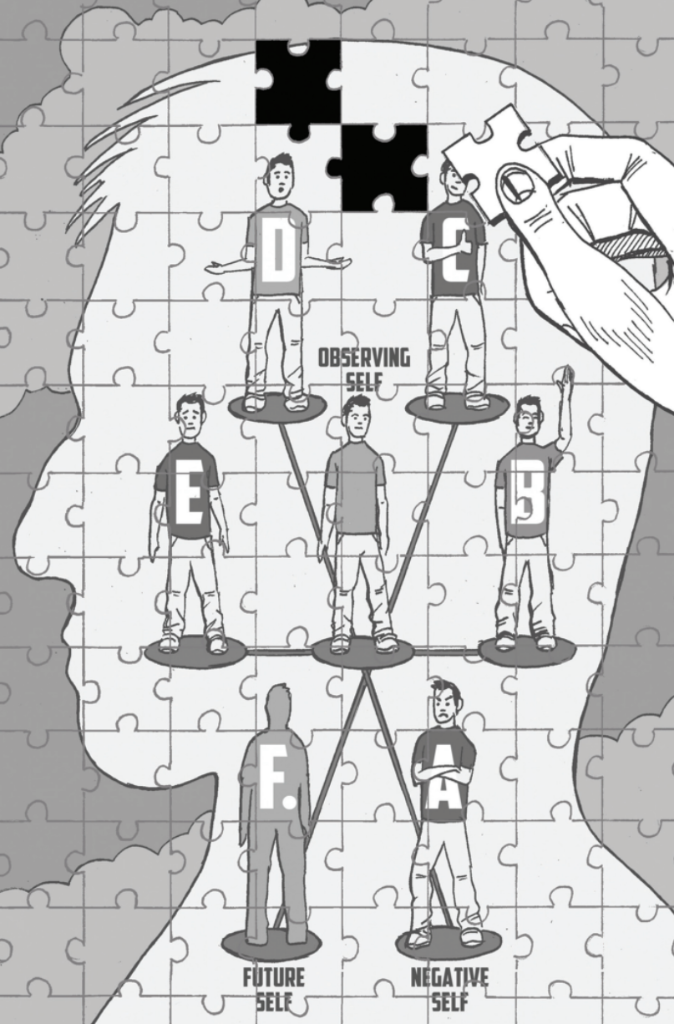
In the illustration, you’ll see your Observing Self surrounded by sub-selves, including your Negative Self (Self A). Between them are the ‘mental’ bridges that allow each of them to swap places, bridges that your Negative Self refused to cross back over on that fateful day. I’ve featured six sub-selves, but you can have as many or as few as you like. Notice they all have different facial expressions to help you decide which part of you they represent. If you want to regain control of your life and enjoy a successful retirement, ideally, you want a group of sub-selves with the attributes that will make this possible. When I do this activity with clients, they’re often surprised by how clever their Negative Self has been in hiding the other sub-selves from view.
Now that you have been introduced, or more accurately reintroduced, to your sub-selves, the next step is to bring them to life by giving each of them its own name, personality, characteristics, and role. Note, you are doing this for your Negative Self, too, but this time, you will be telling them who they are, not the other way around. The list of sub-selves below is an example from one of my clients, but bring yours to life in ways that truly reflect who you want them to be.
A.Negative Self
B.Optimistic Self
C.Compassionate Self
D.Helpful Self
E.Determined Self
F.Future Self
G.Resilient Self
You are welcome to rename your Negative Self as well. One client I worked with overcame her social anxiety, caused by a challenging start to her retirement, by labelling her Negative Self as ‘The Miserable Cow’. While I am not suggesting you use such colourful language, personalising your Negative Self can prove highly effective because it can create greater separation between them and you.
A note on ‘F’. ‘F’ is your Future Self and is dotted deliberately because you are always becoming them without actually being them. ‘F’ is, perhaps, the most critical sub-self in retirement because as you get older, they take on the personalities and roles of the other sub-selves, including your Observing Self. This is why you must separate from your Negative Self; if you don’t, they will ensure that ‘F’ becomes more negative the older you get. With your Observing Self in charge and surrounded by a cast of positive sub-selves, ‘F’ can become who you want them to be.
Taking each sub-self, complete the following activity, paying attention to the tenses used. Notice I use the past tense for your Negative Self i.e., ‘got’; the present tense for your other sub-selves; and the future tense for sub-self, ‘F’, i.e., ‘will’. Using tenses in this way marks the beginning and end of your Negative Self’s reign by consigning them to your past. I have included illustrative examples to help.
My Negative Self (enter a new name, if they have one), and they got me to:
- Think like this: “I’m no longer useful now that I’m retired.”
- Behave like this: Avoid social events because I feel I have nothing to contribute.
- Feel like this: Overwhelmed by anxiety about the future.
- Relate like this: Withdraw from friends and family because I fear being judged for not achieving enough in retirement.
My sub-self B is called (enter name), and they:
- Think like this: “I still have so much to offer, even in retirement.”
- Behave like this: Take up consultancy or volunteering to share my skills and experience.
- Feel like this: Energised by the possibilities ahead.
- Relate like this: Connect openly with others, building new friendships and professional networks.
My sub-selves C, D, E etc., are called (enter names), and they:
- Think like this: “Retirement is a chance to explore new opportunities and reinvent myself.”
- Behave like this: Take proactive steps, such as joining a hobby or interest group or enrolling in a Master’s Degree program.
- Feel like this: Excited about the possibilities and confident in navigating the changes.
- Relate like this: Engage positively with family, friends, and acquaintances, seeking and offering support.
My Future Self, F (enter name), will:
- Think like this: ”I know what matters most to me and have the clarity to keep focusing on it.”
- Behave like this: Take strategic, thoughtful actions that reflect my personal and professional priorities to keep me on track.
- Feel like this: Grounded and assured, with a sense of purpose and calm about what lies ahead.
- Relate like this: Engage meaningfully with others, valuing mutual respect and shared understanding.
My Observing Self is me, and I now:
- Think like this: “I can step back, evaluate my thoughts, and see things clearly without reacting impulsively.”
- Behave like this: Take measured actions, guided by reflection and intentionality.
- Feel like this: Calm and composed, with a sense of control over how I respond to situations.
- Relate like this: Approach others with understanding and curiosity, balancing my needs with theirs.
What did you discover?
Now that you’ve completed the Observing Self activity, take a few moments to reflect on what you noticed. This exercise helps you see more clearly which thoughts, emotions, behaviours, and relationship patterns belong to your Observing Self and which belong to your Negative Self. Your discoveries reveal who’s been leading your life, the calm decision-maker or the restless critic, and how that leadership affects your wellbeing in retirement.
I hope that this activity has put you back in charge and brought forward a group of sub-selves that will play a crucial role in helping you achieve your retirement transformation.
A note of caution: Negative Selves rarely appreciate being sent back to the edge of your life. Expect them to protest, to test boundaries, and to make things difficult for a while. They’ve taken charge before and will feel confident about doing so again. The difference now is that you’ll recognise their tactics. Each time you think, behave, feel, or relate in ways that undermine your progress, you’ll see it for what it is, your Negative Self trying to lure you back into old patterns. Using what you’ve learned in this module, you can anticipate and outwit them.
Reflect on:
- When did your Observing Self feel most present?
- When did your Negative Self try to take over?
- How did your Emotional Self respond to these shifts in control?
- What helps you stay centred in your Observing Self when challenges arise?
Awareness is the turning point. Each time you notice who’s in charge, you strengthen your Observing Self’s authority, restoring balance, confidence, and direction in your retirement.
Like Nicky and Tom, you’ve now seen what happens when your Observing Self steps forward and takes charge.
They both discovered that the power to change their experience of retirement didn’t come from doing more — it came from seeing more clearly who was in control.
Nicky recognised that her Critic had been undermining her confidence and replaced it with a cast of sub-selves that restored balance.
Tom realised that his Perfectionist had kept him busy but unfulfilled and learned to lead with patience, perspective, and warmth instead.
Your task now is the same: keep your Observing Self at the centre.
When it leads, your life begins to align — calm returns, choice expands, and your Negative Self loses its influence.
Each time you notice who’s running the show and choose differently, you strengthen your Observing Self and move closer to the retirement you want to live.
The Meaning Map
The part of you that leads your transformation.
The Observing Self
The Observing Self is the part of you that stands slightly apart from experience, able to notice how you think, behave, feel and relate without being swept away by it. It’s your authentic or core self that observes, reflects, and decides.
In retirement, this self becomes essential. It helps you separate from unhelpful identities and patterns to see clearly and make conscious choices about how you want to live this next stage.
Your Observing Self is the part of you that leads your transformation — the part that wants you to thrive and survive well in retired life.
Session Objectives
Session Objectives – The Observing Self
This session introduces the Observing Self, otherwise known as your core or authentic self — the part of you that oversees your inner and outer worlds, reflects clearly and strategically and makes decisions that support your progress toward and in retirement.
- self_improvementRecognise the role of your Observing Self as the central, guiding presence in your life
- peopleUnderstand how sub-selves influence your thoughts, behaviours, feelings and relationships
- visibilityIdentify when your Observing Self is active and when your Negative Self has taken control
- undoPractise stepping back into your Observing Self to regain perspective and control
- trending_upStrengthen your confidence in leading your own transformation before, during, and after retirement

The Observing Self
The Observing Self and the Brain
For anyone interested in how psychology and neuroscience connect, modern research helps explain the Observing Self in action. When you pause and notice your thoughts, behaviours, feelings and relationships instead of reacting automatically, different areas of the brain come online.
The prefrontal cortex supports awareness, planning, and reflection — the neural base of your Observing Self.
The limbic system, which manages emotion and threat detection, calms when observation replaces reactivity.
Neural integration between these regions improves emotional regulation, decision-making, and perspective.
In retirement, this ability to observe rather than react keeps the mind-body system balanced, allowing you to respond positively and helpfully to change.
Modern science is now proving what ancient traditions understood intuitively: awareness itself heals. The capacity to distance ourselves from what life throws at us and to observe it has always been the key to a well-directed life.

Understanding Your Sub-Selves
Surrounding your Observing Self — who, remember, is the boss, the chief, and the decision-maker — are your sub-selves, distinct parts of you that each play specific roles in your life.
Each sub-self brings particular qualities, characteristics, and ways of thinking, behaving, feeling, and relating to people and situations. They include familiar characters such as the Explorer, the Achiever, the Helper, the Protector, the Carer, and the Organiser.
When your Observing Self is in charge, these parts work in harmony. It brings a sub-self forward when needed, temporarily swapping places to allow them to play their role. When they’ve finished, your Observing Self resumes its central position. This balance ensures that your sub-selves and Observing Self all pull in the same direction. Everyone is working together for your retirement.
The Negative Self
When things go wrong
Sometimes it doesn’t work out this way. Difficulties arise when one particular sub-self refuses to step back — your Negative Self. We all have a Negative Self, and in normal circumstances, they play a valuable role, as we all need to be ‘negative’ at times.
However, unlike other sub-selves, Negative Selves often attempt to cling to power and can dig their heels in when the Observing Self seeks to swap places with them again after they have fulfilled their role.
The impact
From that point, your Negative Self controls how you think, behave, feel, and relate to the world and the people in it — which, as I am sure you can imagine, is not conducive to a successful retirement.
Your task
Restore control to your Observing Self so that it can send your Negative Self back to its intended location — on the periphery of your life alongside your other sub-selves, there to be brought on when needed.
To get a visual representation of the Observing Self Concept, watch my animation.
Form Placeholder
illustration/animation from book/youtube
You Are Not Your Negative Self
When the Negative Self takes control, life becomes difficult. It throws everything at you that it can — all the ‘weapons’ at its disposal to retain control.
Physical & Mental
- arrow_rightPhysical symptoms such as chest pain, stomach issues, and headaches
- arrow_rightNegative, intrusive thoughts
- arrow_rightDifficult emotional states such as stress, anxiety, depression, and anger
- arrow_rightProblematic behaviours such as avoidance, procrastination, or perfectionism
Lifestyle & Social
- arrow_rightUnhealthy lifestyles such as alcohol dependency, drug use, and overeating
- arrow_rightRelationship problems such as irritability or conflict
- arrow_rightSocial issues such as withdrawal or avoidance
- arrow_rightProfessional issues such as work-related stress or Imposter Syndrome

The greatest trick your Negative Self performs is convincing you that you and they are the same person. You are not.
No one chooses to live like this. Yet many people do at various stages of their retirement because they’ve come to believe that this is just how their life is. These experiences belong to your Negative Self — the part that took charge when life became difficult and never relinquished control.
And here’s the simple proof: your Negative Self would never do anything that threatened its control. It wouldn’t have enrolled you on this course or allowed you to progress through it — because Negative Selves never act against their own interests.
That’s how you distinguish between thoughts, behaviours, feelings and relationships that belong to your Observing Self and those that belong to your Negative Self. The former are always consistent with building a successful retirement; the latter always undermines it.
You are your Observing Self — the part that wants to thrive in retirement.
Case Study
Nicky
Reclaiming Control from Her Negative Self
When Nicky retired from a demanding career in education, she expected relief, not confusion. Instead, she found herself anxious, withdrawn, and convinced she was no longer relevant. Her Negative Self — The Critic — had taken charge, shaping her thoughts (“I’m no longer useful”), behaviours (avoiding social events), feelings (anxious, irritable), and relationships (withdrawing from friends and family).
Seeing this in black and white was a turning point. Using her Observing Self, she brought forward her Optimistic Self, her Compassionate Self, and her Determined Self — volunteering locally, mentoring younger teachers, and rebuilding her confidence.
Through commitment and courage, Nicky battled relentlessly with her Negative Self until, eventually, they relinquished control and gave it back to her Observing Self.

Case Study
Tom
Freeing Himself from the Perfectionist
When Tom retired from a successful career in finance, he assumed the pressure would ease. Instead, it followed him home. His Negative Self — The Perfectionist — had taken permanent residence, driving thoughts (“If I don’t do everything properly, I’m failing”), overplanning, micromanaging, and snapping at those he cared about.
Seeing this mapped out gave Tom clarity. Using his Observing Self, he brought forward his Realistic Self (“Good enough is often good enough”), his Compassionate Self, and his Friend Self — restoring balance and warmth to his relationships.
Eventually, The Perfectionist lost its grip, no longer the voice running the show. Tom’s Future Self would think clearly, act without pressure, feel calm, and relate to others with warmth and humour.
The Observing Self
Bringing your sub-selves to life.
The Observing Self Activity
Now your turn. This activity will help you, like it did for Nicky and Tom, to make further sense of why things are as they are by showing you how your Negative Self has been hindering your ability to thrive and survive.
In the illustration, you’ll see your Observing Self surrounded by sub-selves, including your Negative Self (Self A). Between them are the ‘mental’ bridges that allow each of them to swap places — bridges that your Negative Self refused to cross back over on that fateful day.
Now that you have been introduced, or more accurately reintroduced, to your sub-selves, the next step is to bring them to life by giving each of them its own name, personality, characteristics, and role. Note, you are doing this for your Negative Self, too — but this time, you will be telling them who they are, not the other way around.
Your Sub-Selves
My Negative Self and My Sub-Selves
My Negative Self (enter a new name, if they have one), and they got me to: Think, Behave, Feel, and Relate like this… [past tense — their reign is over]
My sub-self B is called (enter name), and they: Think, Behave, Feel, and Relate like this… [present tense]
My sub-selves C, D, E etc. are called (enter names), and they: Think, Behave, Feel, and Relate like this… [present tense]
You are welcome to rename your Negative Self. One client overcame her social anxiety by labelling her Negative Self as ‘The Miserable Cow’. Personalising your Negative Self can prove highly effective because it creates greater separation between them and you.
My Future Self and My Observing Self
My Future Self, F (enter name), will: Think, Behave, Feel, and Relate like this… [future tense] — “I know what matters most to me and have the clarity to keep focusing on it.”
My Observing Self is me, and I now: Think clearly without reacting impulsively. Take measured, intentional actions. Feel calm and composed, with a sense of control. Approach others with understanding and curiosity.
F is dotted deliberately — you are always becoming your Future Self without actually being them. With your Observing Self in charge and surrounded by a cast of positive sub-selves, F can become who you want them to be.
Case Study
Martin
Martin – Grounding the Future
Martin’s first Meaning Map was dominated by the future column, filled with words like “uncertain,” “empty,” and “loss of role.” His Emotional Self was sending messages of anxiety and restlessness, clear messages that he was overextended into the future without the grounding of his past and present strengths.
The anxiety wasn’t the problem itself; it was information, urging him to rebalance his attention. When we revisited his Work and Identity areas, he rediscovered entries that reflected resilience, leadership, and adaptability. As he integrated these across all three timeframes, the anxiety gave way to reassurance.
His Emotional Self responded with a message of inner confidence, showing that balance, not control, was the real antidote to fear about the future.
Case Study
Ruth
Ruth – Integrating the Story
When Ruth completed her Meaning Map, her past, present, and future read like separate stories. Her Emotional Self was sending messages of confusion and weariness, emotions reflecting a fractured sense of identity after decades of caring for others. It was signalling a need for coherence.
By tracing shared values across Home and Family Life, Health and Well-being, and Social areas, Ruth saw how compassion, loyalty, and service connected every stage of her life. As she built “future” goals around them, her Emotional Self responded with a message of calmness mixed with excitement.
The calm she felt was confirmation that her life now made emotional sense again.
Case Study
David
David – Maintaining Time Harmony
David’s Meaning Map was balanced from the start. Each area, Work, Health, Lifestyle, and Social, contained past, present, and future entries that reflected continuity and purpose. His Emotional Self was sending messages of contentment and satisfaction, signals of time harmony.
Together, we used his Meaning Map to check that alignment remained strong as his circumstances evolved. Adding new “future” intentions around community contribution and learning reinforced that balance.
His Emotional Self continued to respond with messages of calmness, confirming that emotional well-being follows naturally when past, present, and future are in dialogue.
Like Alan, Sheila, Martin, Ruth, and David, You’ve Explored How Your Emotional Self Responds to Time
Like Alan, Sheila, Martin, Ruth, and David, you’ve explored how your Emotional Self responds to time — how your past, present, and future influence one another. Their experiences show that emotions are messages: guilt can point to unresolved meaning, sadness to lost connection, anxiety to imbalance, confusion to fragmentation, and calm to alignment.
As you review your own Meaning Map, listen to what your Emotional Self is saying. Each feeling, whether comfortable or not, is information guiding you toward greater harmony across time.
Each feeling, whether comfortable or not, is information guiding you toward greater harmony across time.