Loading progress...
Darwinian Tree
Session Objectives
Session Objectives – The Darwinian Tree
By the end of this session, you will be able to:
Understand how the Darwinian Tree helps hidden ideas evolve.
Learn how to generate emerging thoughts without judgement or overthinking.
Practise evolving early ideas into clearer, more workable possibilities.
Recognise when an idea is ready to be acted upon and when it can be let go.
Begin shaping detailed steps, decisions, and resources for your retirement transformation.
The Darwinian Tree
Transformation
Evolving
Your Ideas
Darwinian Tree Activity
Generating ideas for your retirement transformation isn’t always straightforward. Some ideas sit just below the surface, not yet formed enough to act on. The Darwinian Tree helps you bring those ideas into awareness and evolve them into clear, practical steps.
Follow the activity below using a blank sheet of paper or a blank document on your computer.
parkSteps 1 & 2
The Darwinian Tree
1
2
Steps 3 & 4
The Darwinian Tree
3
4
What Your Darwinian Tree Should Eventually Contain
As the Tree develops, you should begin to see:
Specific objectives or decisions.
People to contact — names, phone numbers, email addresses.
Resources or equipment you might need.
Dates, schedules, or plans.
Techniques or strategies to support your next steps.
These details form the beginnings of your retirement transformation in that area.
“What did the Darwinian Tree reveal about the areas of your retired life that are ready for development?”
What Did You Discover?
Reflect on what the Darwinian Tree activity revealed about your transformation.
What this activity shows you
about your transformation
What did the Darwinian Tree reveal about the areas of your retired life that are ready for development?
Which assumptions about your stage of transformation shifted once you saw your ideas on the page?
What you learned about your
internal systems
What did you notice about the ideas your unconscious offered when you stopped judging or filtering?
What did this teach you about how your mind-body systems respond when given space to generate possibilities?
“Which emerging ideas felt genuinely promising or emotionally persuasive, even if they’re not yet fully formed?”
What Did You Discover?
Reflect on your habits, behaviour and the pull of old and new ideas.
What you noticed about your
habits and behaviour
How did you respond to free-writing without overthinking?
Which behaviours helped the ideas evolve, and which ones held them back?
Where did you see signs of momentum or curiosity that weren’t obvious before?
What you realised about the
pull of old and new ideas
What did this process show you about the old beliefs or routines that still shape your thinking?
Which emerging ideas felt genuinely promising or emotionally persuasive, even if they’re not yet fully formed?
“How does the Darwinian Tree activity change the way you view your retirement transformation?”
What Did You Discover?
Reflect on what you need next and how this reframes your journey.
What became clearer about
what you need next
What support, information, or structure will help the most promising ideas become actionable?
Which personal strengths or preferences surfaced through the ideas you generated?
What becomes possible now that these ideas have evolved into something more concrete?
How this reframes
your journey
How does the Darwinian Tree activity change the way you view your retirement transformation?
What new perspective will help you approach future ideas with less pressure and more openness?
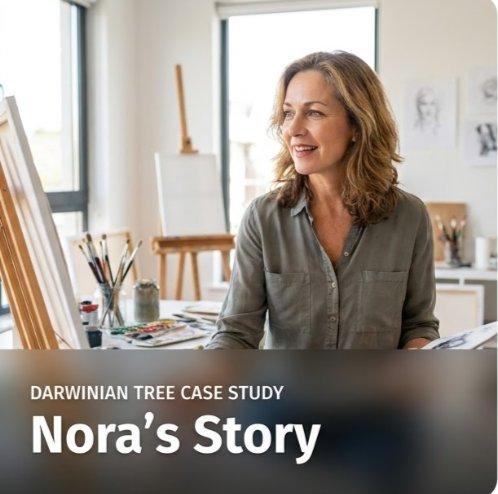
Nora – Clearing the Fog Around Her Next Step
Nora left her role as a probation officer with the vague intention of “doing something creative,” but she couldn’t get beyond that. Her first ten-minute session produced the following, none of which surprised Nora: “old sketchbooks,” “art,” “structure.” Her second set of roots produced something more concrete and exciting: “Try one class before deciding anything,” but more enticingly, “exhibit” and “book illustration.”
In the third round, one idea stood out: enrol in an online illustration course run by an artist she admired. As the years fell away and her love of art returned, she produced a small digital portfolio that her course tutor and fellow students praised as outstanding.
”Knowing she was onto something tangible rather than guessing at possibilities, Nora completed another Darwinian Tree that ended with her setting up an ETSY shop selling her artwork.”

Hassan – Rebuilding Pace After Burnout
Years of high-pressure sales work left Hassan exhausted and unwilling to return to the pace of his working life. His Darwinian Tree roots were minimal: “no pressure,” “cycling,” “fixing things.” The next, which he did a week later, produced ideas of a different magnitude: “repair café,” “teach,” “weekend workshops,” “YouTube.”
After several iterations, the Darwinian Tree revealed two things: he wanted to contribute but also control over his pace of life. His ideas evolved into launching a modest YouTube channel that demonstrated simple repair skills.
”Within months, neighbours started asking for help, and the channel gave him a lifestyle that bore little resemblance to his old career.”
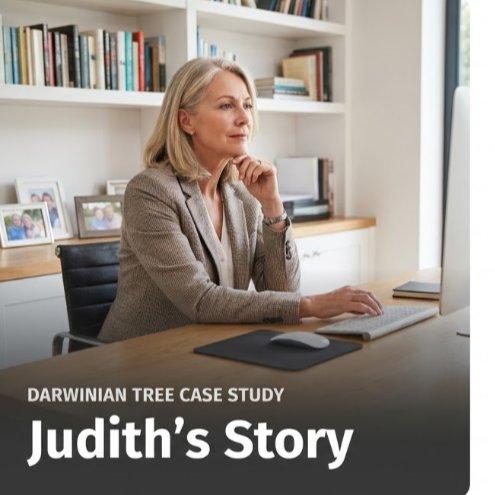
Judith – Making Sense of Empty Space in the Week
Retired Civil Servant, Judith, noticed that parts of her week felt hollow in a way she hadn’t expected. Her first Darwinian Tree session produced factual items that Judith felt were connected even if she couldn’t say why: “Tuesday afternoons,” “old letters,” “photos,” “library card,” “unused scanner.” Her second set of roots added much clearer possibilities: “family history folder,” “digitise photos,” “label everything properly,” “contact cousin in Canada.”
By her third, fourth and fifth rounds, one idea kept growing: build a complete family archive for her children and grandchildren. This developed into scanning decades of photographs, documenting relatives’ stories, organising DNA results, and creating a private online archive.
”Creating her family archive also introduced Judith to a global network of fellow enthusiasts, which led to travelling opportunities and friendships she never imagined.”

Michael – Shifting Away from an Old Professional Identity
Michael had stepped out of a long, reputation-based career. His first Darwinian Tree reflected the objects and habits that had shaped him for decades: “clients,” “briefcase,” “old notes,” “market reports,” “meeting prep,” “training slides.” The second round nudged him towards practical ways to reuse what he already had: “use training slides differently,” “first-job mistakes list,” “finance basics worksheet,” “guest talk at schools and colleges."
"Over later rounds, one idea kept surviving: create a short, practical e-book for young adults on financial basics. Michael self-published it for free, and within weeks, local schools and colleges were using it.”

Sian & Robert – A Couple Negotiating Different Needs
Former academics, Sian and Robert, completed their first Darwinian Tree session together. Sian’s first roots were factual: “lecture notes,” “journals,” “documentaries,” and “membership.” Robert’s first roots were just as concrete: “gardening,” “painting,” and “railways.” Seeing obvious overlaps, the next round saw Sian write: “landscapes,” “environment projects,” “history of local rivers.” Robert wrote: “walks by water,” “historic routes,” “maps and old tracks."
"Across several iterations, one idea stayed alive in both Trees: explore a shared subject rather than a shared activity, which ultimately became: enrol together in an Open University module on environmental history.”
It gave them a joint intellectual project that, critically, as both liked their personal space, avoided identical daily routines. They studied at different times, compared notes when it suited them, and found a way to study without compromising either person’s needs.

Trevor & Jim – Two Long-Term Friends Exploring ‘What Now?‘
As neighbours, Trevor and Jim had always done practical projects together, but retirement brought an unexpected question: what now? Over pints in their local pub, their Darwinian Trees showed how differently they approached the problem. Trevor’s first roots were concrete and mechanical: “engines,” “harbours,” “boats.” Jim’s first roots were equally grounded in his own interests: “tidal maps,” “weather charts,” “OS references,” “navigation books.”
Their second rounds developed far more direction: Trevor added: “restore something,” “simple engine,” “fibreglass repairs.” Jim added: “short coastal routes,” “day sailing,” “learning curve."
"For Trevor and Jim, the idea that survived was to buy an old sailing dinghy and restore it over the course of a year, which well and truly answered their question: ‘What now?’”
New ideas rarely appear fully formed, but arrive in fragments, hints, and small connections that only make sense once they’ve had space to develop. The Darwinian Tree activity creates that space.
Every root you add strengthens the direction you’re moving in, helping your ideas evolve from vague possibilities to realistic, practical actions.
You don’t need certainty for your ideas to evolve, just time, repetition, and a willingness to see what appears next.